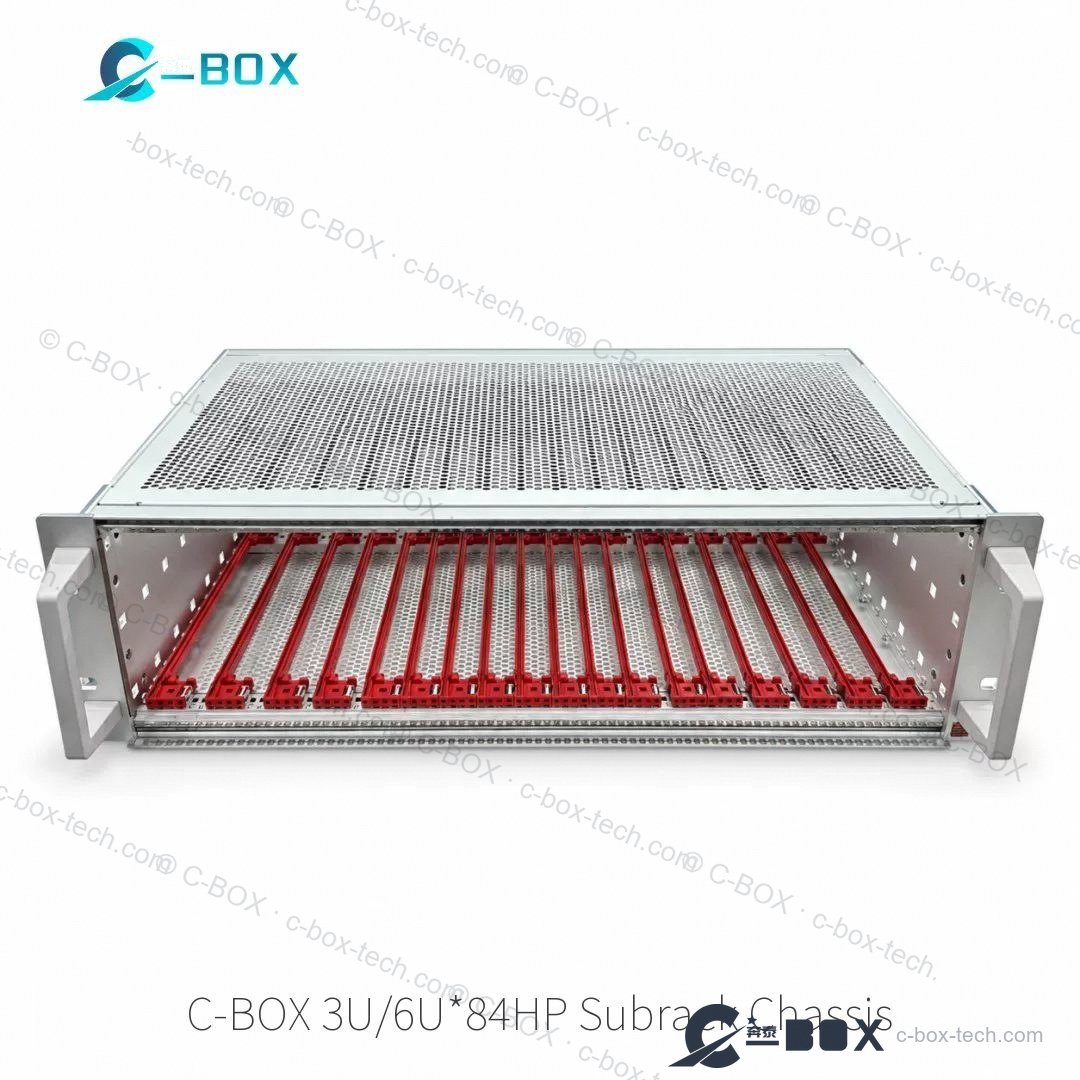
Product line 12 / 12 · VPX Chassis
High-power, high-speed electronics need serious mechanics: VPX and OpenVPX enclosures built for thermal load and signal integrity.

VPX pushes more power and more bandwidth through the same slot, so the mechanical platform has to keep up. Our reference rugged computer is a 4U desktop enclosure built to IEC 60297-3-101 / -102 / -103 and IEEE 1101.1 / .10 / .11: five 3U × 160 mm slots on a VITA 46 full-mesh backplane with 10 GbE fabric and 30 W per slot (reference backplane configuration), rear-I/O on request, and a 300 W pluggable 19″ PSU (3U / 8HP) that swaps without opening the system. Twin centrifugal fans pull air front-to-back across the slots; the shielded aluminium case carries front and rear perforated air intake / exhaust, and heavy-duty EMC guide rails for 3U and 6U boards in 42HP / 63HP / 84HP widths keep every module seated and coded. VPX mechanical and interface requirements follow VITA 46; OpenVPX system interoperability depends on the VITA 65 profile of the selected backplane — send us your profile and we configure the mechanics around it.
Most VPX systems we build are 3U: five or six 3U × 160 mm boards across an 84 HP width on a VITA 46 backplane, with 10 GbE fabric and 30 W per slot in the reference configuration. A 3U VPX chassis is the compact choice when the payload fits one card cage and the heat load is carried front-to-back by the fan pair — the reference unit is a 4U desktop enclosure, and 19″ rack configurations are built on request.
When the board count or the power budget outgrows a 3U cage, the same mechanics take 6U VPX boards: the enclosure grows in height rather than width, and the heavy-duty EMC guide rails are supplied in 3U and 6U versions, 42 HP / 63 HP / 84 HP, with ESD clips. Send us the board format, card depth and slot count and we confirm the rail set and the slot count before quoting.
| Format | 3U / 6U VPX · OpenVPX (VITA 46) |
| Standards | IEC 60297-3-101/-102/-103 · IEEE 1101.1/.10/.11 · backplane per VITA 46, OpenVPX per VITA 65 profile |
| Backplane | reference: VITA 46 full mesh, 10 GbE fabric, 30 W/slot · other backplanes / VITA 65 profiles on request — per-slot power follows the selected backplane |
| Reference unit | 4U desktop, 5 × 3U × 160 mm slots, 275 × 177 mm, rear-I/O option |
| Power | 300 W pluggable 19″ PSU (3U / 8HP) + AC inlet module w/ filter |
| Cooling | 2 × centrifugal fans (36 m³/h each), front-to-back |
| Rails | heavy-duty EMC guide rails, 42HP / 63HP / 84HP, ESD clips |
All values above describe the reference unit, not a general rating. The mechanical platform — enclosure, guide rails, EMC shielding, fan tray and PSU bay — is what C-BOX supplies; backplane fabric, per-slot power and cooling headroom are system-level values that depend on your VITA 65 profile and are confirmed per project. Items marked “on request” are custom builds.
Product video
A guided tour of our 6-slot VPX system chassis — aluminium card guides, ESD hardware and cooling layout, explained by our engineer on the shop floor.
VPX-81046 · 6 slots, 4 U inside / 5 U outside · full-aluminium PCB guide rails
Same interface dimensions as the nVent SCHROFF equivalents — our own tooling, material and finish.
Every model has its own page with specifications and RFQ. Use your browser search (Ctrl/Cmd+F) on this page, or send us the number and we will quote it.
VPX is defined by VITA 46 mechanics and VITA 65 slot profiles. In practice a chassis is chosen by three things: how much payload power each slot has to carry, how the boards are cooled, and whether rear transition modules are part of the system.
| Variable | Typical choice | Mechanical effect |
|---|---|---|
| Format | 3 U or 6 U | 6 U doubles board area and connector rows |
| Cooling | air-cooled or conduction-cooled (VITA 48) | conduction needs a cold wall and wedge locks, not a fan tray |
| Slot count | 8 slot (3 U), 12 slot (6 U) and up | sets width in HP and the guide rail count |
| Rear transition | RTM per slot or rear cabling | adds depth and a rear opening per slot |
| Power per slot | payload power budget per slot profile | drives the backplane and the PSU, not the sheet metal |
Air-cooled VPX uses the same front-to-rear path as any 19″ chassis and is the cheaper route for lab and ground systems. Conduction-cooled VPX removes heat through the card edges into a cold wall: it needs wedge locks, a machined card guide with a defined thermal path, and a chassis designed as a heat sink. The two are different products, not options on one part number, and the choice is usually set by the environment rather than by preference.
A slot profile fixes which lanes and which utility signals appear at each slot position. Two chassis with the same slot count but different profiles will not accept the same card set, so the profile is part of the requirement, not a detail to be resolved later. If the card set is fixed by a programme, quote the profile; if it is still open, tell us the modules and their lane requirements and we will say which profiles support them.
Where this product line is typically used.
A 3U VPX chassis is 3 U high inside the card cage, so the board is 100 × 160 mm — or 100 × 220 mm for long boards — and the rack width is usually 84 HP: five 3U slots at 1 inch pitch, six where the pitch and the rear connectors allow it. Height and width are the easy part. What decides whether a standard enclosure fits your payload is board depth, rear-I/O cut-outs, connector keep-out and the PSU bay. Send those three and we check them against the 84 HP mechanics family we hold in stock, starting with the 84 HP VPX cross member (34562-984), its heavy-duty guide rails and the rail fittings that go with them.
OpenVPX does not define a single backplane — the VITA 65 profile does. An OpenVPX chassis can be built around a full-mesh, dual-star or hybrid profile, and the slot count, connector windows, keying and rear-I/O cut-outs all follow from that choice, not the other way round. C-BOX supplies the mechanics: card cage, rails, cross members, panels, gasket and PSU bay, machined to the connector positions of the backplane you specify. Wondering why so few OpenVPX backplanes are catalogue items? The technical note on backplane and mechanics from one supplier explains what to check in monitoring, cooling and 19-inch integration before you fix a profile.
When a VPX enclosure leaves the lab, the mechanics change: conduction-cooled card cages with wedge locks instead of airflow, stiffened side walls and corner extrusions instead of a plain shell, captive fasteners, sealed front panels and shock mounts sized to the transit profile. We build these as drawing-specific jobs rather than catalogue variants — outline dimensions, wall thickness, finish (anodised, AlZn-coated or painted) and mounting interface are all set by your drawing or by a reference unit you send us. See the own-brand and custom range for what is configurable, or send a competitor’s part number and we confirm dimensional equivalence first.
VPX rarely stands alone in a rack. Most of our VPX customers buy the surrounding mechanics from the same drawings family: IEC 60297 3U/6U 84 HP subracks for the boards that do not need a VITA 46 fabric, PICMG 2.0 CompactPCI chassis where the payload is still cPCI, and PXI Express chassis when the test rack shares the same 3 U Eurocard mechanics. Guide rails, cross members, handles and coded front panels are common across all four lines — which is why one RFQ usually covers the whole rack.
Parts that usually go together with VPX Chassis.
Related categories
Answer these seven points and we can tell you within one working day whether a standard platform fits — or what a custom build needs:
| Selection item | What to confirm on your side | What we do with it |
|---|---|---|
| Board format | 3U or 6U, board depth (160 mm / 220 mm / other) | Selects slot geometry and rail set |
| System architecture | VPX or a specific OpenVPX slot / backplane profile (VITA 65) | Defines slot pitch, keying and rear-I/O cutouts |
| Backplane | Topology (full mesh / dual star / BIC), slot count, connector & signal needs | Bay layout, connector windows, EMI gasketing — backplane sourced to your profile |
| Cooling | Air-cooling, conduction-cooled, or both; ambient temperature range | Fan tray sizing, airflow path, conduction frame fit |
| Power | AC / DC input, total PSU rating, per-slot power budget | PSU bay and inlet module selection, sharing limits per project |
| Mechanics | Outline dimensions, mounting (19″ rack / desktop / wall), front-panel layout | Enclosure variant and machining per drawing |
| Environment | Shock, vibration, temperature, EMC / ESD targets | Shielding level, reinforced rails, gasket & grounding choices |
C-BOX supplies the mechanical platform: enclosures, subracks, guide rails, cross members, panels and PSU mechanics. Electronic modules and the backplane are specified by you — OpenVPX interoperability depends on the VITA 65 profile of the selected backplane, and we configure the mechanics around it. System-level parameters such as fabric, power and thermal targets are confirmed per project.
A 4U desktop rugged computer enclosure with five 3U × 160 mm slots on a VITA 46 full-mesh backplane (reference configuration), front-to-back forced-air cooling via twin centrifugal fans, rear-I/O on request and a 300 W pluggable 19″ PSU that swaps without opening the system. Other slot counts, 6U builds and rack or wall formats are configured per project.
Dimensional mechanics follow IEC 60297-3-101/-102/-103 and IEEE 1101.1/.10/.11. VPX mechanical and interface requirements follow VITA 46; OpenVPX system interoperability is defined by the VITA 65 profile of the backplane you select.
Yes. Custom sheet-metal chassis, panels and machining are a core part of our business. Send your drawing, BOM line or a supplier part number — we confirm dimensional equivalence, material and finish, then quote.
The reference platform uses front-to-back forced-air cooling with twin centrifugal fans and perforated front and rear air intake / exhaust. Other thermal concepts are reviewed per project — send your thermal targets with the RFQ and our engineering team will assess feasibility.
3U or 6U configuration and slot count · VITA 65 profile or backplane drawing · cooling approach · PSU input and rating · board depth · any custom machining, panel or mounting requirements. Standard mechanics are quoted within 24 hours; custom platforms get a feasibility reply the same day.
Air-cooled VPX uses a 1.0″ / 25.4 mm pitch with a front-to-back airflow path and a fan tray sized to the slot power. Conduction-cooled boards need wedge locks, a cold wall and a defined thermal path from the board edge to the frame, and they typically allow a wider ambient range. The choice changes rails, slot pitch, card guides and the enclosure, so state it before the outline drawing.
Made in our own plants — chassis and precision parts from Kunshan, cabinets and surface finishing from Hefei: CNC punching, press braking, CNC machining, assembly, inspection and export packing in-house.
Kunshan plant →Hefei plant →Send us your system requirements, backplane layout or mechanical drawing. Our engineering team will review the required slot configuration, cooling approach, power supply and mechanical interface, then come back with a feasibility answer and quotation.
Standard mechanics are quoted within 24 hours; custom platforms get a feasibility reply the same day.